
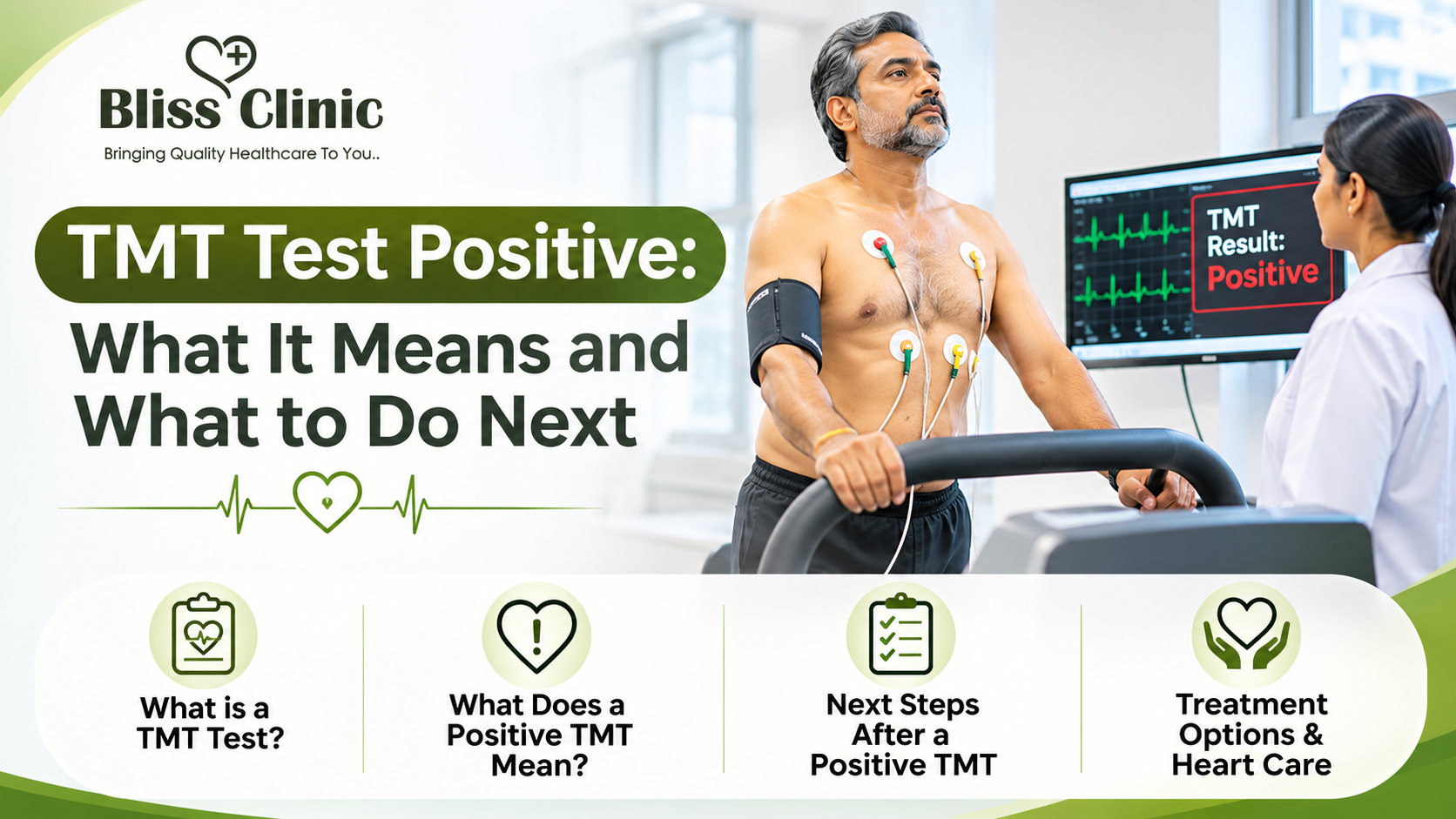
TMT Test Positive: What It Means and What to Do Next
Medically reviewed by Dr. Nurul Abbas Noorani, MBBS, PGDCC, PGDGM · Clinical Cardiologist, Bliss Clinic · Last updated [07-11-2026]
Quick answer:
A positive TMT (Treadmill Test) result may suggest that the heart muscle is not receiving enough blood during exercise. However, it does not automatically confirm coronary artery blockage. Understanding the TMT test positive meaning requires reviewing your ECG changes, symptoms, exercise capacity, and overall cardiac risk. Your doctor may recommend further investigations depending on the findings.
What is a TMT test?
A TMT (treadmill test, or exercise stress test) records your ECG, heart rate and blood pressure while you walk on a treadmill that gets faster and steeper every 3 minutes. Exercise makes the heart work harder. If an artery is narrowed, the reduced blood supply often shows up on the ECG under stress, even when the resting ECG is normal.
What do TMT results mean?
| Result | What the report usually says | What it means |
| Negative (normal) | No significant ST changes; target heart rate achieved | Low chance of a significant blockage. Keep controlling risk factors |
| Positive | ST depression of 1 mm or more during or after exercise, sometimes with chest pain | Suggests reduced blood flow to the heart; needs further evaluation |
| Strongly positive | Changes at a low workload (early stage), large ST changes, BP drops, serious rhythm problems | Higher chance of significant blockage; your doctor may advise early angiography |
| Inconclusive | Target heart rate (85% of age-predicted maximum) not reached, or a baseline ECG that cannot be read | Cannot answer the question; another test is needed |
Many reports also give a Duke Treadmill Score, which groups you as low, moderate or high risk. Ask your doctor to explain yours.
Can a TMT be a false positive?
Yes. TMT is a good screening test but not a perfect one. On average it correctly picks up about 2 in 3 people with significant blockages, and some people without blockages test positive. False positives are more common in:
- Women, especially before menopause
- People with high BP and a thickened heart muscle (LVH)
- People on certain medicines, e.g. digoxin
- Low potassium or other electrolyte imbalance
- Mitral valve prolapse
- Baseline ECG changes such as bundle branch block
This is why a positive TMT is a reason for a proper review, not panic, and why the next step depends on your whole picture, not the TMT alone.
What happens after a positive TMT?
- Cardiologist review. Your symptoms, risk factors (diabetes, BP, cholesterol, smoking, family history) and the exact TMT findings are assessed together.
- 2D Echo. Checks pumping strength (EF) and whether any part of the heart wall moves poorly. See 2D Echo test.
- CT coronary angiography or a stress echo/nuclear scan. Often advised when the TMT is mildly positive and symptoms are unclear. These are non-invasive ways to confirm or rule out blockages.
- Coronary angiography. Advised when the TMT is strongly positive, symptoms are typical, or other tests show a significant blockage.
- Treatment plan. Based on the confirmed findings: medicines and lifestyle change, angioplasty, bypass, or, for chronic angina that persists despite medicines, EECP therapy.
Is a positive TMT dangerous?
The result itself is not an emergency. It is a warning to act on soon. The exception is if you now have chest pain at rest, pain lasting more than 15 minutes, or pain with sweating or breathlessness. In that case, call 108 or go to an emergency department immediately.
TMT positive but angiography normal: what now?
This happens. It may be a false-positive TMT, or a problem in the heart’s tiny blood vessels (microvascular angina) that angiography cannot see. If you still have symptoms, ask your doctor about control of risk factors and whether further evaluation is needed. A normal angiogram is good news about the large arteries.
How to prepare for a TMT (to avoid inconclusive results)
- Eat a light meal 2–3 hours before; avoid a heavy meal
- Wear comfortable shoes and loose clothing
- Ask your doctor before the test whether to take or pause your heart medicines. Do not stop any medicine on your own
- Tell the technician about knee, hip or back problems that make walking difficult
TMT at Bliss Clinic, Ahmedabad
Bliss Clinic does TMT, ECG and 2D Echo under one roof. Dr. Noorani reviews your report the same day and explains what it means for you, including when further tests are and are not needed.
Book a TMT or report review: +91 99131 02300 · opposite Vishala Circle, Ahmedabad.
This article is for general information and does not replace a doctor’s assessment.
FAQ
What does TMT positive mean? It means the ECG showed changes during exercise that suggest reduced blood flow to the heart muscle. It needs confirmation with a doctor’s review and further tests.
Does a positive TMT mean I have a blockage? Not always. Many positive TMTs are due to significant blockages, but false positives happen, especially in women and people with high BP. An echo, CT angiography or angiography confirms it.
What is the next step after a positive TMT? See a cardiologist with your report. Depending on how strongly positive it is and your symptoms, you may need a 2D Echo, CT coronary angiography or conventional angiography.
What does an inconclusive TMT mean? You did not reach your target heart rate, or the ECG could not be interpreted. The test did not answer the question, so another test, such as a stress echo or CT angiography, may be advised.
Can I avoid angiography after a positive TMT? Sometimes. If the TMT is mildly positive and you have few symptoms, non-invasive tests like CT coronary angiography may be enough. A strongly positive result usually needs angiography.
How accurate is a TMT? It detects about 2 in 3 people with significant blockages, and its accuracy is lower in women and in people with abnormal resting ECGs. That is why results are read together with symptoms and other tests.